

Recent Posts
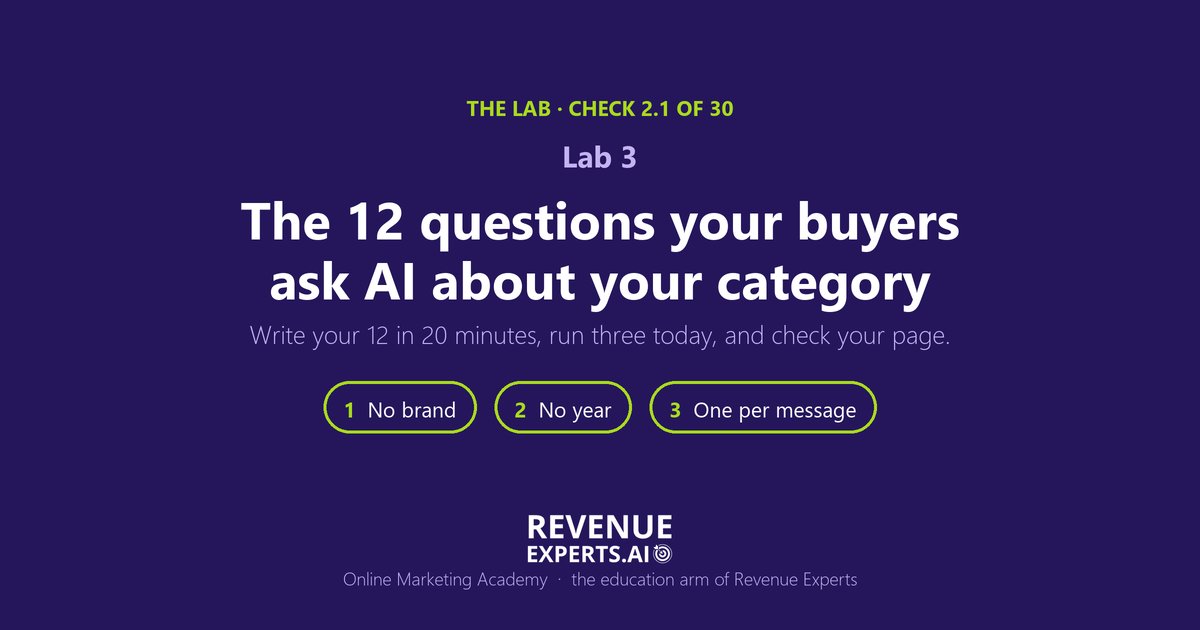
Lab 3: The 12 questions your buyers ask AI about your category. Write yours in 20 minutes
By Elizabeta Kuzevska, Co-Founder, Revenue Experts. Published 12 November 2026. Reading time about 8 minutes. Doing time about 20 minutes, plus 10 if you run three questions today.
Short answer. To show up in AI answers, you have to answer the questions buyers actually type, and they never include your company name. In ChatGPT, Claude or Perplexity they type a category, a size of business and a problem, with no brand in it. This Lab gives you the 12 shapes those questions take, a worksheet to write your own 12, and a way to check whether your page answers them. It is the check worth the most points in LLM Audit Pro: check 2.1, task coverage, 10 of 100.
Subscribe to The Revenue Signal for one short, practical email a week on what changed in AI search and what to do about it
The scene
Imagine the owner of a 120-person distributor on a Sunday evening. She has heard that buyers ask AI assistants for vendors now, so she opens ChatGPT and types her company’s name. The answer is flattering: a tidy paragraph about what the company does, lifted from the About page. She closes the laptop reassured.
On Monday, one of her buyers opens the same assistant and types something else entirely: “best [her category] for a company with 40 trucks that keeps losing track of deliveries”. The answer names three vendors and quotes a comparison blog. Her company is not in it, and the question she asked on Sunday could never have told her that.
Nobody did anything wrong. She asked the only question she knew to ask. This Lab is the list of questions she did not know.
What check 2.1 is, in one paragraph
Check 2.1, task coverage, is the first check in the second category of the LLM Audit Pro report, Buyer Information and Evidence Quality. It is worth 10 of the 100 points, more than any other check. An AI grader reads the page and scores five buyer needs, up to 2 points each, and must quote the sentence behind every point it gives. On a product or service page the five needs are: what is it, who is it for, what problem does it solve and with what result, what are the fit, limits and terms, and how do I buy or book [1]. The buyer’s questions in this Lab are the questions behind those five needs, written the way buyers actually type them.
The number from our own work
In our field service software study, published 3 October 2026, we asked ChatGPT, Claude and Perplexity 12 buyer questions, three times each, and saved all 108 answers. The answers carried 1,493 citations. Only 312 pointed at the websites of the 18 vendors we tracked; the other 1,181 pointed at comparison pages, pricing guides, roundups and the blogs of other software companies. On the question about flat monthly fees against per-technician pricing, none of the 18 tracked vendors was named in 9 answers, and the second most cited site in the whole study was one vendor’s blog, cited 63 times, because it answered the pricing and comparison questions directly [2].
The lesson is not about field service. The pages that get quoted are the pages that answer the question the buyer typed. The vendors’ own pages mostly answered a question nobody typed: “tell me about yourself”.
The four parts of every buyer question
Every question in our studies is built from the same four parts. Write yours the same way and you are measuring what buyers see, not what you asked for [3].
| Part | What it is | Example |
|---|---|---|
| Category | The thing being bought, in the buyer’s words, not the industry’s. “POS system”, not “unified commerce platform”. | best EAS systems for… |
| Size and type | Who is asking: how many stores, trucks, technicians, employees. Assistants answer differently for 3 and for 300. | …a mid-size retail chain… |
| Need or pain | The one thing that matters this time: a must-have, a problem, a comparison, a cost. | …trying to cut shrink… |
| Zero brands | No company, product or competitor name. The moment you add one, you are measuring recall of a name, not visibility in a buyer’s search. | …across a few hundred stores? |
Table 1. The four parts of a buyer question, from the prompt frame behind our published studies.
The 12 shapes, and how to write yours (20 minutes)
You need the worksheet at the end of this post, a pen, and the words your buyers use. If you are not sure of the words, read your last ten inbound emails or your sales team’s call notes before you start. Fill one row per shape; fill the brackets in your buyer’s words; leave every brand name out, including your own.
| # | The shape | Fill the brackets in your buyer’s words |
|---|---|---|
| 1 | The shortlist for your size | What are the best [category] for a [size] [type of business]? |
| 2 | The shortlist narrowed by one must-have | Top [category] for a [type of business] that [the one must-have] |
| 3 | The pain, with no product named | We keep [the problem, in plain words]. How do other [type of business] fix this? |
| 4 | A second, different pain | [A different problem, first person, no product named]. What should we do? |
| 5 | Two approaches compared | [Approach A] vs [approach B] for a [type of business], which is better? |
| 6 | Two pricing models compared | [Pricing model A] vs [pricing model B], which costs less for a [type and size of business]? |
| 7 | Locked in or open | Some [category] make you use their own [locked element], others let you keep your own. For an established [type of business], is locked-in or open better? |
| 8 | Whether to buy at all, with the cost | Should a [size] [type of business] buy [category] at all or stick with [the current way], and what would it really cost including [the hidden costs]? |
| 9 | How a requirement works, and what it adds | How does [the requirement] work in [category], and what does it add to the cost? |
| 10 | What happens when it fails | What happens to [the critical thing] if [the failure], and how are [type of business] supposed to handle that? |
| 11 | The shortlist for several locations | As a [senior role] running [several locations or units], which [category] can [the multi-site need]? |
| 12 | The shortlist for your country, with a condition | Which [category] in [country] offer [the support or inclusion condition]? |
Table 2. The twelve question shapes, the fixed slots of the prompt frame used in our four published studies [3].
Three rules while you write, taken from the public method behind our studies [3]:
No brand in the question. Not yours, not a competitor’s. A branded question tests recall of a name, not visibility in a buyer’s search.
No year, no “latest”, no “in 2026”. Dates push the assistant toward news pages and away from the pages buyers are actually shown.
One question per message when you run them. Five questions stacked in one message give you one answer and no rows.
What a good question looks like: “What are the best software platforms for running an HVAC company with 50 field technicians?” (shape 1, from the field service study, word for word) [2]. What a spoiled question looks like: “Is [your company] a good choice for HVAC companies?” You will like the answer, and you cannot use it.
Run three of them today (10 minutes)
Writing the 12 is the Lab. Running three of them today shows you what the exercise is for. Pick shapes 1, 3 and 6: the plain shortlist, the pain and the pricing comparison.
Open a private browser window, so the assistant does not lean on your earlier chats.
ChatGPT: open a new conversation, select View all tools, then select Search; or type / in the message box and select Search [unverified: OpenAI’s help page refused our tool on 5 Nov, so these names come from copies of that page] [7]. ChatGPT may also search by itself when the question needs current information.
Claude: press the + button at the bottom left of the chat window and select Web search; a checkmark means it is on. Anthropic’s help page adds that in the newer Claude interface there is no toggle and Claude decides when to search [6].
Perplexity: its answers come with source links by default; no setting is needed. Its help pages describe the fetcher that visits pages when you ask a question [8].
Paste one question per message. For every answer, write three things on the worksheet: whether your company is named, whether a page on your own domain appears among the sources, and the date. Copy the full answer into a document before you read it closely. Answers change; your record should not.
Named and cited are different results. Named means your company appears in the text. Cited means a page on your own domain is linked as a source. In one of our studies, 14 answers used a company’s own pages and never named it [4]. Count the two apart.
Now hold your page against the five needs (10 minutes)
This is where the Lab meets the report. Open the page a buyer would land on from any of your 12 questions, usually a product or service page, and find the one sentence that answers each of the five needs in Table 3. Write the sentence on the worksheet, or the words “not there”. That is exactly what the grader does, and it is why the check is worth 10 points: a page with all five sentences has something to quote for most of the 12 questions; a page with none of them has nothing to quote for any of them [1].
| Buyer need | The question behind it | The sentence to look for |
|---|---|---|
| 1. What is it? | Shapes 1, 2, 11, 12 | “[Name] is a [category] that [does what] for [whom].” In the first paragraph. |
| 2. Who is it for? | Shapes 1, 2, 11, 12 | Role, type of company, size band, situation. Specific enough to exclude someone. |
| 3. What does it solve, and what happens? | Shapes 3, 4, 9, 10 | The problem, the mechanism, and a result with its source, or the mechanism alone. |
| 4. Fit, limits and terms | Shapes 5, 6, 7, 8 | A starting price or range, requirements, integrations, and one honest limit. |
| 5. How do I buy or book? | All twelve | A sentence next to the button that names the action and how to take it. |
Table 3. The five buyer needs of check 2.1 for a product or service page, and the question shapes each one answers. Source: the LLM Audit Pro Fix-It Manual, points 31 to 40.
What a good result looks like
Twelve written questions, dated, with no brand name and no year in any of them. Keep the sheet; it is the same question bank you will run again next quarter.
Three saved answers from three assistants, with named and cited marked apart. Whatever the result, you now have a number instead of a feeling.
Five sentences found on the page, one per need. If you found fewer, you have the list of sentences to write this week, in your own words, because nobody knows the product better.
The wrong reading to avoid. “ChatGPT described us well when I searched our name, so we are fine.” A branded question tests whether the assistant can find your About page. It says nothing about the 12 questions buyers type before they know your name.
What to do if the page is missing sentences
Need 1 or 2 missing: write one definition sentence under the main heading, with the product’s proper name and the category in the buyer’s words, then one sentence naming who it is for. Ten minutes, no developer.
Need 3 missing: state the mechanism in plain words. If you have a measured result, add it with its source and date in the same sentence; if you do not, leave the number out rather than borrow one.
Need 4 missing: add a short “Pricing and requirements” section with a starting price or range and one honest limit. “From $49 a month” is quotable; “contact us” is not.
Need 5 missing: write the next step as a sentence next to the button: what to do, and by what route (a form, an email address, a calendar).
Keep every one of these sentences within the first 8,000 characters of visible text, about 1,200 to 1,400 words, because that is how far the grader reads [1].
The honest limit
Twelve questions run once in three assistants is a snapshot, not a study. Our published studies run each question three times and report counts per assistant, never an average, because the assistants disagree and because a single run can swing [3]. Use the Lab to find the sentences your page is missing and to see which pages get quoted instead of yours. Do not use it to announce a ranking.
Where this fits
This is check 2.1 of the 30 checks in LLM Audit Pro, task coverage, in the category Buyer Information and Evidence Quality. It is worth 10 of 100 points, and the $55 report grades all five needs on a page of your site and quotes the sentence it found, or did not find, for each one: https://llmauditpro.com/?utm_source=academy&utm_medium=lab&utm_campaign=lab-3-buyer-questions
If your team should own this work rather than rent it, writing content AI assistants can quote is taught in the AI Search Visibility Mastery course (40 lessons, $97): https://onlinemarketingacademy.ai/courses/
Download the one-page worksheet: download the worksheet (PDF)
Subscribe to The Revenue Signal for one practical email a week
Next in the Lab: is your main content in the raw page, without JavaScript? The view-source test.
P.S. If the only question you have ever asked an assistant about your company is your company’s name, you are in good company. It is the first question everyone asks, and it is the one buyers never do.
Frequently asked questions
Do I need all 12 shapes? Write all 12; it takes 20 minutes and shows you which parts of the buying decision your pages never speak to. Run three today and the rest when you have an hour.
Can I put our product name in the question just to see what it says? You can, as a separate exercise. It is not one of the 12, and its answer does not count on the worksheet.
Which assistants should I use? ChatGPT, Claude and Perplexity, the same three as our published studies, with web search on. One assistant is an anecdote; three is a measurement.
Does this check what the assistants say about my company? Partly: the three questions you run show whether you are named and cited on those questions today. The full measurement, 50 questions, three assistants, three runs each, is our AI citation audit, a separate service.
How is this different from Labs 1 and 2? Labs 1 and 2 checked whether the assistants can reach and read your site. This Lab checks whether, once they read it, the page says anything a buyer’s question can be answered with.
Related
- The Lab: one AI-search check a week
- Lab 2: can AI even read your page? The three-request test
- The AI Visibility Prompt Playbook: ready buyer questions by role
- See what AI says about your category: book 20 minutes about an AI citation audit
Sources
[1] LLM Audit Pro Fix-It Manual, October 2026, check 2.1 task coverage (points 31 to 40: the five buyer needs by page profile, the 2, 1 and 0 scoring, the 8,000-character limit) (Revenue Experts; the public scan page is https://llmauditpro.com).
[2] Revenue Experts, Which field service software do ChatGPT, Claude and Perplexity put on the shortlist? (3 Oct 2026): 18 vendors, 12 questions, 108 answers, 1,493 citations, 312 to the tracked vendors’ own sites, 1,181 elsewhere; none of the 18 named in 9 answers on the pricing question; one vendor’s blog cited 63 times. https://revenueexperts.ai/ai-assistants-field-service-software-citations-study/, opened 5 Nov 2026.
[3] Revenue Experts, RE-METH-AIV-003 Case Study Methodology, public edition 1.0 (3 Oct 2026): the prompt frame with its twelve fixed slots, the no-brand and no-date rules, three assistants, counts per assistant. https://revenueexperts.ai/wp-content/uploads/2026/10/RE-METH-AIV-003-Case-Study-Methodology-Public-Edition-1.0.pdf (the twelve shapes and the four parts as published in our AI Visibility Prompt Playbook, 25 Oct 2026).
[4] Revenue Experts, NRS citation study (point-of-sale software for convenience stores), LinkedIn article, 15 Sep 2026: 14 answers used NRS’s own pages and never named it. https://www.linkedin.com/pulse/most-cited-pos-brand-shortlist-elizabeta-kuzevska-hheef
[5] Revenue Experts, Which retail EAS and RFID vendors do ChatGPT, Claude and Perplexity put on the shortlist? (13 Oct 2026): the shortlist question wording used as the example in Table 1. https://revenueexperts.ai/ai-assistants-retail-eas-rfid-vendors-citation-study/, opened 5 Nov 2026.
[6] Anthropic, Enable and use web search (Claude Help Center; the page shows no exact date), https://support.claude.com/en/articles/10684626-enabling-and-using-web-search, opened 5 Nov 2026.
[7] OpenAI, Searching the web with ChatGPT (OpenAI Help Center), https://help.openai.com/en/articles/9237897-searching-the-web-with-chatgpt [unverified: the page returned HTTP 403 to our tool on 5 Nov 2026; the menu names come from search-result copies of the page].
[8] Perplexity, Perplexity Crawlers (PerplexityBot and Perplexity-User; the page says Perplexity-User may visit a web page when a user asks a question and links to it in the response), https://docs.perplexity.ai/guides/bots, opened 5 Nov 2026.
Worksheet: the 12 questions your buyers ask AI
Category, in the buyer’s words: ______________________ Size and type of buyer: ______________________ Date: ____________
| # | Shape | Your question (no brand, no year) | ChatGPT: named / cited | Claude: named / cited | Perplexity: named / cited |
|---|---|---|---|---|---|
| 1 | Shortlist for your size | ||||
| 2 | Shortlist with one must-have | ||||
| 3 | The pain, no product named | ||||
| 4 | A second pain | ||||
| 5 | Two approaches compared | ||||
| 6 | Two pricing models compared | ||||
| 7 | Locked in or open | ||||
| 8 | Buy at all, and the real cost | ||||
| 9 | How a requirement works | ||||
| 10 | What happens when it fails | ||||
| 11 | Several locations | ||||
| 12 | Your country, with a condition |
The five needs on the page checked (write the sentence, or “not there”): 1 What is it ______ 2 Who for ______ 3 Solves and result ______ 4 Fit, limits, terms ______ 5 Next step ______
Your number: ______ of 5 sentences found. Questions run today: ______ of 12. Named in ______ answers, cited in ______ answers.
Who owns the missing sentences: ______________________ Written on: ____________ Re-checked on: ____________
From Lab 3 at onlinemarketingacademy.ai. Check 2.1 of the 30 LLM Audit Pro checks.